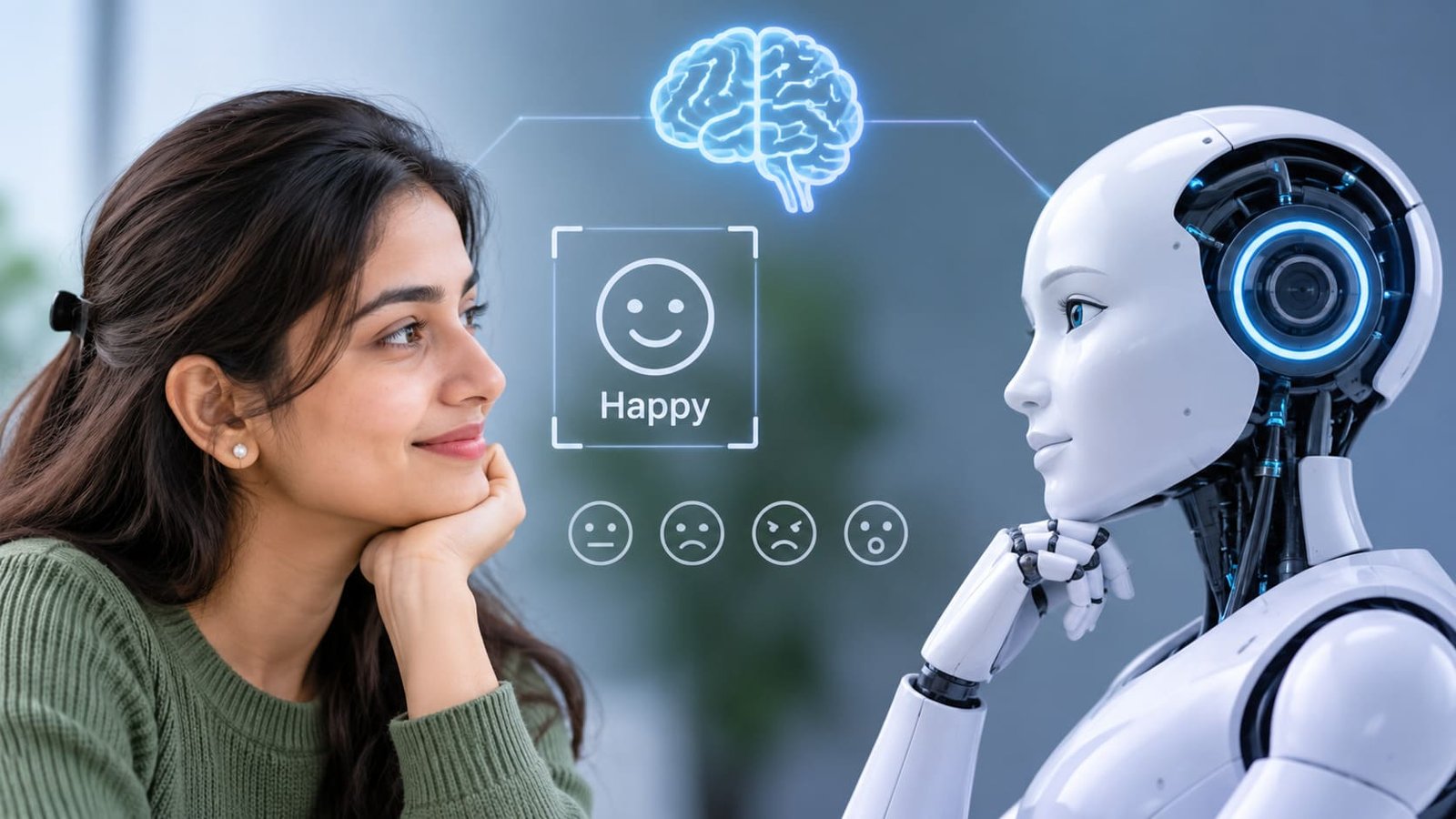
Artificial intelligence is becoming a part of everyday life. From virtual assistants and customer support chatbots to healthcare applications, AI systems are learning to interact with people in increasingly natural ways. But one interesting question remains: Can AI actually understand human emotions?
Humans communicate through more than words. Our facial expressions, tone of voice, gestures, and reactions often reveal how we feel. Emotional AI aims to recognize and interpret these signals, helping machines respond in ways that are more appropriate to human emotions.
Although AI cannot experience feelings like humans do, advances in emotional recognition technology are changing how people interact with digital systems. This development could influence education, healthcare, customer experiences, and many other industries.
What Is Emotional AI?
Emotional AI, also known as affective computing, refers to technology designed to recognize, analyze, and respond to human emotional signals.
These systems use artificial intelligence, machine learning, and other technologies to identify possible emotional patterns from different sources, including:
- Facial expressions and eye movements
- Speech patterns and changes in voice
- Written language and word choices
- Body movements and behavioral signals
- Interaction patterns with digital devices
For example, an AI-powered customer support system might identify frustration in a person’s voice and adjust its response to provide clearer assistance.
However, recognizing an emotional signal does not mean a machine truly understands what someone is experiencing. Emotional AI makes predictions based on available information, and those predictions can sometimes be incorrect.
How Does Emotional AI Work?
Emotional AI combines several technologies to interpret human communication and behavioral signals. Each technology contributes a different piece of information.
1. Facial Expression Recognition
AI-powered vision systems can analyze facial movements and expressions to identify patterns that may be associated with emotions such as happiness, sadness, or surprise.
These systems examine features around the eyes, eyebrows, and mouth. However, facial expressions can vary between individuals and cultures, so they should not be treated as reliable proof of someone’s emotional state.
2. Voice and Speech Analysis
The way people speak can communicate information beyond the words they use. Changes in pitch, speaking speed, volume, and pauses may provide clues about their emotional condition.
AI systems analyze these characteristics to estimate whether a speaker sounds calm, frustrated, excited, or uncertain.
3. Natural Language Processing
Natural Language Processing (NLP) allows AI systems to examine written and spoken language.
For example, an AI application can analyze customer feedback to identify positive comments, complaints, concerns, or expressions of dissatisfaction.
This technology helps businesses understand communication patterns and respond more effectively.
4. Behavioral Pattern Analysis
Some emotional AI systems examine patterns in how people interact with applications and digital platforms.
Changes in typing behavior, response times, and interaction habits may provide additional context. However, these patterns can have many explanations and should not be interpreted as definitive emotional evidence.
Where Is Emotional AI Being Used?
Emotional AI is gradually finding applications across different industries. Its potential value comes from helping digital systems respond more appropriately to human communication.
1. Healthcare and Patient Support
Healthcare applications can use conversational AI to make digital interactions more supportive and accessible.
For example, virtual health assistants may recognize language indicating distress and encourage users to seek appropriate professional support.
These systems should complement healthcare professionals rather than replace human judgment or clinical assessments.
2. Education and Online Learning
Every student learns differently. Some may need additional explanations, while others prefer moving through lessons more quickly.
AI-powered learning platforms can examine student interactions, quiz performance, and feedback to identify when learners may need extra assistance.
This can help educators create more responsive learning experiences without assuming that technology can accurately determine how every student feels.
3. Customer Experience
Businesses are exploring emotional AI to improve customer communication.
For example, customer service platforms can analyze feedback and conversational language to identify common frustrations or satisfaction patterns.
This information can help support teams improve their responses and understand what customers expect from a product or service.
4. Automotive Technology
Modern vehicles increasingly use intelligent systems to improve driver assistance and safety.
Some research explores whether in-car monitoring systems can identify signs of fatigue or reduced attention through observable behavior.
Such applications may provide additional safety signals, although they should not rely on uncertain emotional predictions alone.
5. Human-Computer Interaction
Emotional AI could make digital assistants, applications, and interactive devices more responsive to the way people communicate.
Instead of providing the same response to every user, future systems may adjust their language, interaction style, and recommendations based on conversational context.
Benefits of Emotional AI
Emotional AI offers several potential advantages when it is designed and used responsibly.
- More Natural Communication: AI systems may respond more appropriately to conversational context and emotional signals.
- Improved Customer Support: Businesses can identify recurring customer concerns and improve service quality.
- Personalized Learning: Educational platforms can adapt learning experiences based on student progress and feedback.
- Better Accessibility: Emotion-aware interfaces may offer alternative ways for people to interact with digital services.
- More Responsive Technology: Applications can become more flexible instead of relying entirely on fixed responses.
The real value of emotional AI lies in supporting human interactions, not replacing human empathy.
Challenges and Ethical Concerns of Emotional AI
Despite its potential, emotional AI raises important questions about privacy, accuracy, and responsible technology development.
Privacy and Personal Data
Facial images, voice recordings, and behavioral information can contain sensitive personal details. Organizations must ensure that such information is collected and processed responsibly.
Accuracy and Cultural Differences
People express emotions differently. A facial expression or speaking pattern that appears meaningful in one situation may have a completely different explanation in another.
AI systems can therefore make incorrect assumptions about someone’s feelings.
Bias in AI Systems
If emotional recognition systems are trained on limited or unrepresentative datasets, their performance may vary across different populations.
Developers need diverse training data, regular testing, and clear limitations to reduce these risks.
Consent and Transparency
People should know when an AI system is analyzing their emotional signals and understand how their information is being used.
Clear consent, appropriate data protection, and meaningful human oversight are essential.
What Is the Future of Emotional AI?
The future of emotional AI will likely focus on making digital interactions more context-aware and responsive.
As AI models improve, researchers may develop systems that combine language, voice, visual information, and conversational context to generate more useful responses.
However, technical progress does not mean machines will develop genuine human emotions. AI can recognize patterns and generate emotionally appropriate language without experiencing happiness, sadness, or empathy.
The next stage of development will depend not only on technological improvements but also on how responsibly organizations introduce these systems into everyday life.
Conclusion
Emotional AI is opening new possibilities for the way humans interact with technology. From customer support and education to healthcare and digital assistants, emotion-aware systems may help create more responsive and personalized experiences.
However, recognizing emotional signals is not the same as understanding human feelings. Accuracy, privacy, transparency, and cultural differences must remain important considerations as this technology develops.
Ultimately, the most useful emotional AI systems will be those that support human decisions, improve communication, and make technology more helpful without attempting to replace genuine human connection.
Frequently Asked Questions
1. What is Emotional AI?
Emotional AI is a technology that uses artificial intelligence to analyze facial expressions, voice patterns, and language to identify possible human emotions.
2. Can AI actually understand human emotions?
AI can recognize patterns associated with emotions and generate suitable responses. However, it cannot genuinely experience or feel emotions like humans.
3. Where is Emotional AI used?
Emotional AI is being explored in healthcare, education, customer service, automotive technology, and digital assistants to improve human-computer interactions.
4. What are the challenges of Emotional AI?
Major challenges include data privacy, inaccurate emotional predictions, cultural differences, algorithmic bias, and the responsible use of personal information.