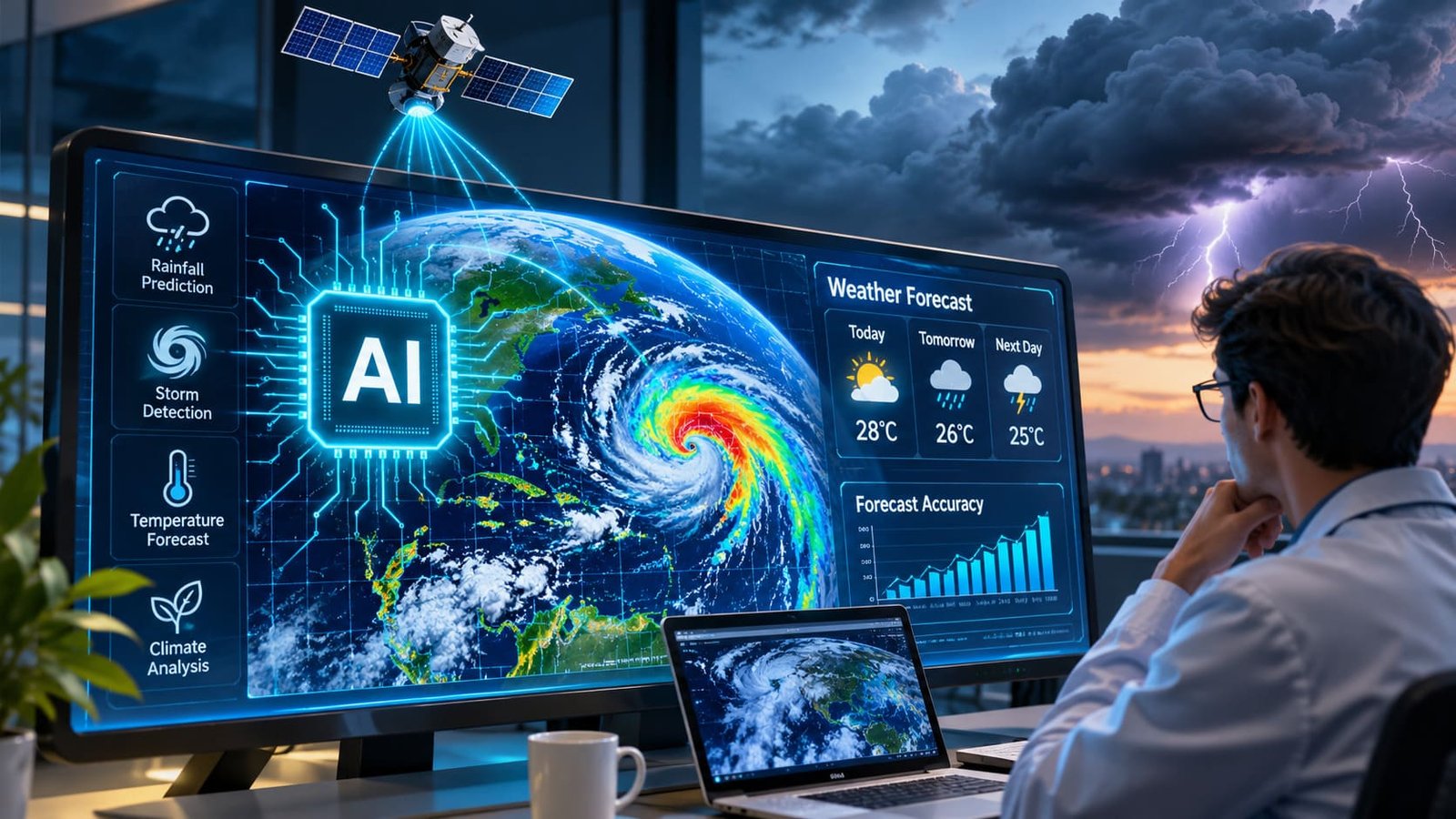
Have you ever planned a trip because the weather forecast showed clear skies, only to experience unexpected rain a few hours later? Situations like these remind us how difficult it can be to predict the weather accurately.
Weather influences many everyday decisions. Farmers depend on rainfall predictions to protect their crops, airlines monitor changing atmospheric conditions, and families check forecasts before planning outdoor activities. Even a small change in weather can affect people’s plans and, in some situations, create serious challenges.
For many years, weather forecasting has depended on satellites, radar systems, weather stations, and scientific calculations. These methods have helped meteorologists understand atmospheric conditions, but predicting sudden changes remains challenging.
Now, artificial intelligence is bringing new possibilities to this field. By studying large amounts of weather information, AI can help researchers recognize patterns, understand changing conditions, and improve the way forecasts are developed.
Artificial intelligence is not taking the place of meteorologists. Instead, it is giving them another way to study the atmosphere and make better-informed predictions.
Why Predicting the Weather Is Still Difficult
Weather may look simple when we check a temperature or rainfall update, but the science behind a forecast is much more complicated.
Temperature, humidity, wind direction, air pressure, and ocean conditions all influence one another. A change in one area can affect weather conditions somewhere else. This makes forecasting a continuous process of collecting information, studying patterns, and updating predictions.
There are several reasons why accurate forecasting remains difficult.
- Rapid weather changes: Storms and rainfall systems can develop faster than expected.
- Limited observations: Some remote locations and ocean regions have fewer weather monitoring facilities.
- Complex atmospheric behaviour: Different weather conditions interact in ways that are difficult to predict.
- Large amounts of information: Meteorologists must examine information collected from satellites, radar systems, and weather stations.
These challenges explain why researchers are exploring artificial intelligence as an additional tool for understanding weather conditions.
How Artificial Intelligence Is Making Weather Forecasting Better
AI is changing how weather information can be studied. Instead of relying only on conventional forecasting calculations, researchers can also use machine learning to examine historical records and current atmospheric observations.
Let’s understand where this technology is making a difference.
1. Understanding Weather Data More Quickly
Every day, weather monitoring systems collect enormous amounts of information. Satellites capture images of cloud movement, radar systems track rainfall, and weather stations record temperature, humidity, and wind conditions.
Finding useful patterns in all this information takes considerable effort.
AI systems can examine these datasets and identify relationships between different weather conditions. For example, they may recognize similarities between current atmospheric observations and patterns recorded during previous weather events.
This gives meteorologists additional information when studying how weather conditions might develop.
2. Recognizing Early Signs of Severe Weather
One of the most important uses of weather forecasting is helping people prepare for dangerous conditions.
Heavy rainfall, thunderstorms, and powerful storms can create problems for communities, roads, agriculture, and public infrastructure. Getting useful information early can make preparation easier.
AI-powered systems can examine satellite images, radar information, and atmospheric measurements to identify patterns associated with developing storms.
These insights can help meteorologists investigate changing conditions and assess possible risks.
However, AI predictions are not always correct. Human experts still need to evaluate the information before issuing important weather warnings.
3. Helping Improve Rainfall Predictions
Rainfall is especially important in countries where agriculture and daily activities depend heavily on seasonal weather conditions.
Farmers need to understand when rain is likely to arrive, while local authorities must prepare for possible waterlogging and flooding.
AI models can study previous rainfall records alongside current atmospheric conditions to estimate possible precipitation patterns.
For example, information about humidity, cloud development, and changing temperatures can help researchers examine whether rainfall conditions are becoming more likely.
Better rainfall information can support agricultural planning, water management, and local preparedness.
4. Making Local Weather Forecasts More Useful
Have you ever noticed that one part of a city experiences heavy rain while another area remains completely dry?
Weather does not always behave the same way across an entire region. Local geography, wind patterns, temperature differences, and atmospheric conditions can influence what happens in individual locations.
AI can help researchers combine information from different monitoring sources to understand these regional differences.
This could make local forecasts more useful for farmers, commuters, businesses, and people planning outdoor activities.
However, accurate local predictions still depend on having enough reliable observations from the areas being studied.
5. Helping Scientists Study Long-Term Weather Changes
Weather forecasting and climate research are not exactly the same, but both depend on understanding environmental conditions.
Weather forecasting focuses on what may happen over the coming hours or days. Climate research examines longer-term patterns, including changes in temperature, rainfall, and atmospheric conditions.
AI can help researchers examine historical climate records and identify patterns across large environmental datasets.
This may support studies into changing rainfall patterns, rising temperatures, and unusual weather conditions.
The technology does not replace climate science. It simply provides researchers with additional ways to study complicated environmental information.
Real-World Examples of AI in Weather Forecasting
Artificial intelligence is no longer just an idea being discussed in research laboratories. Several technology organizations and weather institutions are already developing AI-based forecasting systems.
Here are three interesting examples.
Google DeepMind – GraphCast
Google DeepMind developed GraphCast, a machine learning system designed to produce global medium-range weather forecasts. It uses historical and atmospheric data to predict how weather conditions may change.
The development demonstrated how machine learning could contribute to faster and competitive global weather prediction.
Microsoft – Aurora
Microsoft introduced Aurora, an AI foundation model designed for atmospheric and environmental forecasting. It can work with different types of environmental information and support several prediction tasks.
Its development highlights the possibility of using one AI model across different environmental research applications.
ECMWF – Artificial Intelligence Forecasting System
The European Centre for Medium-Range Weather Forecasts (ECMWF) has developed its Artificial Intelligence Forecasting System, known as AIFS.
It uses machine learning to generate global weather forecasts and works alongside traditional forecasting approaches.
These examples show that AI is becoming an important part of modern weather research.
How Better Weather Predictions Can Help Everyday Life
The value of improved forecasting goes beyond knowing whether tomorrow will be sunny or rainy.
It can influence decisions across several industries and communities.
Agriculture: Farmers can use weather information to plan irrigation, protect crops, and prepare for changing rainfall conditions.
Transportation: Airlines, shipping companies, and road transport services can use forecasts to understand possible weather-related disruptions.
Disaster management: Authorities can use improved weather information when preparing for storms, heavy rainfall, and other potentially dangerous conditions.
Energy management: Weather predictions can help energy providers estimate electricity demand and understand the availability of renewable energy from solar and wind sources.
Daily planning: Individuals and businesses can make more informed decisions about travel, outdoor activities, and work schedules.
These examples demonstrate why weather forecasting matters far beyond weather applications.
Challenges That Artificial Intelligence Still Needs to Overcome
Although AI offers several promising possibilities, it is important to understand that predicting the weather is not a problem that technology can solve completely.
The quality of an AI forecast depends heavily on the information used to develop and operate the model. If weather observations are incomplete or inaccurate, predictions may also become less reliable.
Another challenge involves unusual weather events. AI systems learn from existing information, so they may struggle when atmospheric conditions develop in ways that are poorly represented in their training data.
There are also concerns about computing resources, model reliability, and understanding why a particular prediction was generated.
Most importantly, AI-generated forecasts should not be accepted without evaluation. Meteorologists must compare predictions with scientific observations and other forecasting systems before making important decisions.
This is why combining AI technology with human expertise remains essential.
What Could the Future of Weather Forecasting Look Like?
As AI technology develops, weather forecasting could become more detailed and responsive to changing environmental conditions.
Future forecasting systems may combine information from satellites, ocean monitoring equipment, ground sensors, and advanced machine learning models to provide a clearer picture of atmospheric behaviour.
We may also see stronger connections between weather forecasting and everyday services.
For example, farmers could receive more relevant rainfall information, transportation companies could prepare for changing weather conditions, and emergency management teams could use improved forecasts when planning their response to natural disasters.
Another interesting possibility is the development of more location-specific forecasts. Rather than depending entirely on general predictions for an entire city, people could receive information that better reflects conditions in their surrounding areas.
These developments will take continued research, reliable data, and cooperation between meteorologists and technology experts.
Conclusion
Weather forecasting has always involved uncertainty. Even with advanced scientific equipment and powerful computing systems, understanding exactly how atmospheric conditions will change is a difficult task.
Artificial intelligence is creating new opportunities by helping researchers study weather information, recognize patterns, and develop improved forecasting approaches.
From rainfall predictions to storm monitoring, its applications could make weather information more useful for individuals, businesses, farmers, and governments.
However, AI should be viewed as a supporting technology rather than a replacement for meteorological expertise. Reliable forecasts will continue to depend on scientific knowledge, accurate observations, and careful analysis.
As these technologies develop together, the future of weather forecasting could become more informative, accessible, and helpful in preparing people for changing weather conditions.
Frequently Asked Questions
1. How is artificial intelligence used in weather forecasting?
Artificial intelligence analyzes weather data from satellites, radar systems, and weather stations to identify atmospheric patterns and help meteorologists improve weather predictions.
2. Can AI predict storms and heavy rainfall?
Yes, AI can examine satellite images, radar information, and atmospheric conditions to identify patterns associated with developing storms and heavy rainfall. These predictions help meteorologists assess potential weather risks.
3. Is AI more accurate than traditional weather forecasting methods?
AI forecasting models have shown strong results in several weather prediction tasks. However, accuracy depends on weather conditions, available data, and forecasting periods. Traditional forecasting methods and AI can work together to improve predictions.
4. Will artificial intelligence replace meteorologists in the future?
No, artificial intelligence is more likely to support meteorologists than replace them. Weather experts are still needed to evaluate predictions, understand unusual atmospheric conditions, and communicate reliable weather information.