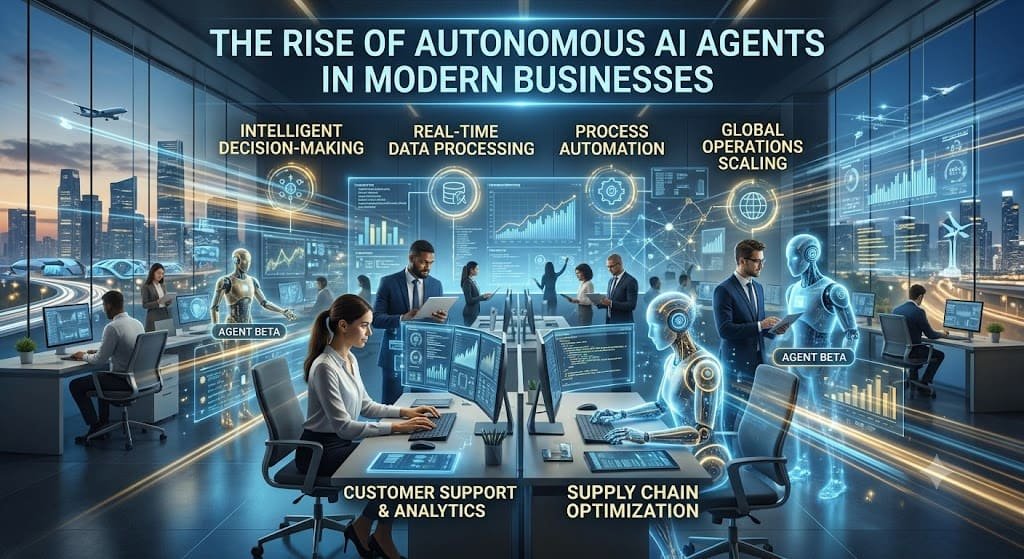
Artificial intelligence is changing the way modern businesses operate. From answering customer questions to analyzing large amounts of data, AI has already become a valuable part of everyday business activities. However, the next stage of this transformation goes beyond tools that simply respond to instructions. Businesses are now exploring autonomous AI agents that can plan tasks, make decisions within defined boundaries, and complete workflows with less human intervention.
The rise of autonomous AI agents represents an important shift in how organizations use technology. Instead of relying on people to manage every step of a process, companies can use AI agents to handle connected tasks, respond to changing information, and support faster decision-making.
This does not mean that human employees are becoming unnecessary. Rather, autonomous AI agents are creating new opportunities for people to focus on strategic planning, creative thinking, relationship building, and complex problem-solving.
As this technology continues to develop, understanding how AI agents work, where they provide value, and what risks they introduce will become increasingly important for businesses of every size.
What Are Autonomous AI Agents?
Autonomous AI agents are software systems designed to work toward specific goals by observing information, selecting actions, and carrying out tasks with varying levels of independence. Unlike traditional software that follows a fixed sequence of instructions, an AI agent can evaluate a situation and determine the next appropriate step within its assigned permissions.
For example, a conventional customer support chatbot might answer a question using its available information. An autonomous AI agent could potentially identify a customer’s issue, retrieve relevant account information, check an order status, prepare a suitable response, and escalate the case when human assistance is required.
These capabilities depend on the agent’s design, the tools it can access, the quality of its information, and the safeguards established by the organization.
AI agents may use large language models, external applications, business databases, APIs, and workflow automation systems to perform their assigned responsibilities. Some agents operate independently on simple tasks, while others require approval before taking important actions.
Why Are Businesses Adopting Autonomous AI Agents?
Businesses are under constant pressure to improve productivity, manage operating costs, and deliver better customer experiences. Autonomous AI agents offer a potential way to address these challenges by reducing repetitive work and coordinating activities across different systems.
Several factors are contributing to their growing adoption.
1. Reducing Repetitive Work
Many employees spend significant time performing routine activities, including organizing documents, updating records, preparing reports, and responding to common requests. These responsibilities are necessary but can limit the time available for more valuable work.
AI agents can help automate suitable tasks by collecting information, processing requests, and preparing outputs. For example, a sales operations agent might organize incoming leads, check whether required information is missing, and notify a team member when a lead needs attention.
This allows employees to concentrate on activities that require human judgment and communication.
2. Improving Business Productivity
Traditional workflows often involve several disconnected steps. Employees may need to switch between applications, transfer information manually, and wait for updates before continuing their work.
Autonomous AI agents can coordinate certain steps across connected tools. A reporting agent, for instance, could gather approved data sources, identify important changes, and prepare a summary for a manager.
The potential benefit is not simply completing individual tasks faster. It is reducing delays between related activities and helping teams maintain a smoother workflow.
3. Supporting Faster Decisions
Businesses generate information from customer interactions, sales activities, operational systems, and market changes. Reviewing all this information manually can take considerable time.
AI agents can help organize relevant data, highlight patterns, and prepare recommendations for decision-makers. A retail business might use an agent to identify unusual changes in product demand or flag inventory levels that require attention.
However, AI-generated recommendations are not automatically correct. Important decisions still require reliable data, appropriate context, and human oversight.
4. Delivering More Responsive Customer Support
Customer expectations continue to evolve. People often want quick answers, clear updates, and assistance that reflects their specific situation.
AI agents can help support teams by retrieving relevant information, categorizing requests, drafting responses, and managing straightforward workflows. With suitable integrations and permissions, some agents may also complete routine service actions.
More complicated cases, sensitive customer concerns, and exceptions should be transferred to qualified human employees.
How Autonomous AI Agents Are Transforming Different Business Functions
The impact of AI agents extends beyond a single department. Their practical value depends on whether they can solve a clearly defined problem and integrate safely with existing business processes.
Marketing and Sales
Marketing teams can use AI agents to organize campaign information, summarize audience research, identify potential customer segments, and support content planning. Sales teams can use them to prepare meeting summaries, update customer relationship management records, and identify follow-up opportunities.
For example, an agent could review information from an approved CRM system and prepare a list of leads that may need attention. A salesperson can then evaluate those suggestions and decide how to proceed.
The goal is to support better-informed marketing and sales activities rather than automate every customer interaction.
Human Resources
Human resources departments manage numerous administrative tasks, including answering employee questions, organizing onboarding materials, and coordinating recruitment processes.
An AI agent can help new employees locate company policies, explain onboarding steps, or direct requests to the appropriate department. During recruitment, it may assist with scheduling interviews and organizing application information.
Sensitive employment decisions, such as hiring, promotion, and disciplinary action, require appropriate human judgment and safeguards against unfair outcomes.
Finance and Accounting
Finance teams frequently work with invoices, expense reports, transaction records, and financial documentation. AI agents can assist with extracting information, checking documents for missing fields, matching records, and flagging unusual transactions.
For example, an agent might identify an invoice that does not match a purchase order and send it for review instead of allowing it to proceed automatically.
This approach can improve efficiency while preserving approval procedures for payments and other high-impact financial activities.
IT Operations and Cybersecurity
Technology teams must monitor systems, investigate alerts, resolve technical issues, and maintain reliable infrastructure. AI agents can assist by collecting diagnostic information, summarizing alerts, suggesting troubleshooting steps, and routing incidents to the correct specialists.
In cybersecurity, an agent might correlate alerts from approved monitoring systems and prepare an incident summary for an analyst.
Automated containment or system changes can be useful in carefully controlled environments, but they require strict permissions, testing, audit logs, and clear escalation procedures.
Customer Service
Customer service is another area where AI agents can support daily operations. They can help categorize support tickets, retrieve product information, summarize previous conversations, and prepare responses based on approved company resources.
When a request involves a refund, account access, a complaint, or a complicated technical issue, the agent should follow established authorization rules and transfer the case when necessary.
This combination of automation and human support can help businesses serve customers more consistently without removing the personal assistance that many situations require.
Autonomous AI Agents vs. Traditional Automation
Although both technologies can improve efficiency, they approach work differently.
| Feature | Traditional automation | Autonomous AI agents |
|---|---|---|
| Working method | Follows predefined rules and workflows | Uses context and goals to select actions |
| Handling changes | Often requires explicit rule updates | May adapt within its design and permissions |
| Decision-making | Primarily rule-based | May use AI-generated reasoning and tool results |
| Best suited for | Stable, predictable processes | Tasks involving changing information and multiple steps |
| Human oversight | Depends on the workflow | Especially important for uncertain or high-impact actions |
Traditional automation remains highly effective for predictable, repetitive processes. Autonomous AI agents can be useful when a task requires interpreting information, coordinating multiple actions, or responding to changing conditions.
In many businesses, the strongest approach will combine both technologies rather than replace existing automation entirely.
Challenges Businesses Must Consider
Despite their potential, autonomous AI agents introduce important technical, operational, and ethical challenges. Organizations should understand these limitations before giving agents access to business-critical systems.
Data Privacy and Security
AI agents may handle customer records, internal documents, financial information, or confidential business data. If access controls are poorly designed, an agent could expose information or perform actions beyond its intended responsibilities.
Businesses should apply least-privilege access, protect sensitive data, monitor activity, and restrict access to approved systems.
Inaccurate Outputs
AI agents can misunderstand instructions, misinterpret information, or produce incorrect conclusions. If an agent uses unreliable information to complete a workflow, the error may affect subsequent tasks.
Companies should validate important outputs, test agents against realistic scenarios, and require human approval for actions where mistakes could cause significant harm.
Uncontrolled Actions
An agent that can send messages, modify records, issue refunds, or change system settings may create problems if its permissions are too broad.
Organizations should establish clear limits on what agents can do independently. High-impact actions should use approval checkpoints, transaction limits, and reliable rollback procedures wherever possible.
Integration and Maintenance
Business systems are often built using different technologies and data formats. Connecting an AI agent to multiple applications can require substantial technical work.
Agents also need ongoing monitoring as business processes, software, policies, and data change. Successful deployment therefore requires more than simply choosing an AI model.
Employee Trust and Accountability
Employees may be concerned about job changes, monitoring, or decisions made by systems they do not fully understand.
Businesses should communicate the purpose of AI adoption, provide appropriate training, and explain who remains responsible for the agent’s actions and outcomes.
Best Practices for Implementing Autonomous AI Agents
Businesses do not need to automate every process at once. A measured approach can help them evaluate benefits while reducing unnecessary risk.
1. Start with a clear business problem. Choose a repetitive, measurable workflow where an AI agent can provide practical value.
2. Begin with limited permissions. Allow the agent to retrieve information or prepare recommendations before granting authority to change records or perform transactions.
3. Connect trusted data sources. Ensure that the agent uses accurate, relevant, and appropriately authorized information.
4. Keep humans involved in important decisions. Establish approval requirements for financial transactions, sensitive customer requests, security changes, and other high-impact actions.
5. Measure actual performance. Track task completion rates, error frequency, processing time, operating costs, and employee feedback.
6. Monitor and improve continuously. Review failures, test new scenarios, update safeguards, and adjust the agent as business requirements evolve.
By following these practices, organizations can develop a clearer understanding of where autonomous AI agents are useful and where conventional software or human expertise remains the better choice.
The Future of Autonomous AI Agents in Modern Businesses
The future of autonomous AI agents is likely to involve more connected systems that can coordinate tasks across departments. Instead of relying on a single agent for every responsibility, businesses may use several specialized agents that collaborate under shared rules and centralized oversight.
For example, a supply chain workflow might involve one agent monitoring inventory, another preparing supplier information, and a third generating delivery updates. A human manager could supervise the process, resolve exceptions, and approve decisions with significant financial or operational consequences.
Advances in AI models, software integration, monitoring, and security may make these systems more capable over time. However, progress will depend not only on technical performance but also on reliability, cost, governance, and organizational readiness.
Businesses that establish strong data practices and clear accountability now will be better positioned to evaluate future developments. The objective should not be maximum autonomy at any cost. It should be dependable automation that creates measurable value while keeping people in control of important decisions.
Conclusion
Autonomous AI agents are becoming an important part of the conversation about the future of business technology. Their ability to interpret information, coordinate tasks, and work across connected applications creates opportunities to improve productivity in marketing, sales, finance, customer service, human resources, and IT operations.
At the same time, these capabilities introduce challenges involving security, accuracy, accountability, and human oversight. Businesses must address these concerns before allowing AI agents to perform consequential actions independently.
The most effective strategy is to begin with practical use cases, establish clear boundaries, and measure real-world results. When implemented responsibly, autonomous AI agents can help organizations reduce repetitive work, improve operational efficiency, and give employees more time to focus on meaningful business goals.
The rise of autonomous AI agents is not simply about making software more intelligent. It is about building a more effective partnership between human expertise and AI-driven capabilities.
Frequently Asked Questions
1. What are autonomous AI agents in business?
Autonomous AI agents are software systems that can analyze information, plan actions, and perform assigned tasks with limited human intervention. Businesses use them to automate workflows, support decisions, and improve productivity.
2. How do autonomous AI agents help modern businesses?
They help businesses manage repetitive tasks, organize data, support customer service, coordinate workflows, and prepare useful insights. Their effectiveness depends on the quality of the data, available tools, and human oversight.
3. What are the main risks of using autonomous AI agents?
Key risks include inaccurate outputs, data privacy issues, security vulnerabilities, and unauthorized actions. Businesses can reduce these risks through access controls, testing, monitoring, and human approval for sensitive decisions.
4. Will autonomous AI agents replace human employees?
Autonomous AI agents are more likely to change many job responsibilities than eliminate the need for all employees. They can handle suitable repetitive tasks while people focus on creativity, complex problem-solving, relationship building, and strategic decisions.