Artificial intelligence is becoming better at answering questions, recognizing images, and generating content. However, a new area of AI research is focused on something more advanced: helping machines understand how the world works and predict what might happen next.
This is where world models in AI come into the picture.
Instead of responding only to the information they receive, AI systems equipped with world models aim to develop an internal representation of their surroundings. They can use that representation to anticipate possible outcomes, evaluate different actions, and make better-informed decisions.
This capability could become particularly important in robotics, autonomous vehicles, scientific research, and other applications where understanding real-world conditions matters.
What Are World Models in AI?
A world model is an internal representation that an AI system uses to understand its environment and estimate how that environment might change over time.
Think about a robot moving through a warehouse. Before taking a turn, the robot needs to consider its current position, nearby objects, possible obstacles, and the consequences of its movement. A world model can help the system estimate what might happen if it chooses one route instead of another.
The same general idea applies to other environments. An AI system might model traffic conditions, predict the movement of objects, or estimate how a physical system will respond to a particular action.
World models do not necessarily reproduce every detail of reality. Instead, they focus on the information needed for a particular task.
For example, a warehouse robot may not need to understand the color of every object. It needs to recognize obstacles, estimate distances, and predict whether a path is safe.
How Do World Models Work?
World models generally combine information about the current environment with learned patterns about how that environment changes.
Although implementations differ, the process often involves several important stages.
1. Learning From Data
First, the AI system learns patterns from information such as images, videos, sensor readings, simulations, or recorded interactions.
By studying these examples, the model can learn relationships between objects, actions, and outcomes. A system trained on driving scenarios, for instance, may learn that a vehicle approaching an intersection can change direction or slow down.
The quality and variety of the training data influence how well the model can represent unfamiliar situations.
2. Building an Internal Representation
Next, the system organizes the information into a representation that captures important features of its environment.
This representation might include the positions of objects, movement patterns, environmental conditions, or relationships between different elements.
The goal is not necessarily to create a perfect digital copy of the real world. It is to preserve the information needed to make useful predictions.
3. Predicting Possible Outcomes
Once the model has learned relevant patterns, it can estimate what may happen under different conditions.
For example, a robot might predict whether moving forward will bring it too close to an obstacle. An autonomous system might estimate how nearby vehicles could move over the next few seconds.
These predictions are estimates, not guarantees. Unexpected events, incomplete observations, and unfamiliar conditions can still lead to incorrect results.
4. Evaluating Actions Before Taking Them
One of the most useful capabilities of a world model is the opportunity to test possible actions internally.
An AI system can compare different choices by estimating their likely consequences before acting in the real environment. This can reduce the need for costly or risky trial and error.
A robot, for instance, might compare two routes through a crowded space and select the one that appears safer and more efficient.
5. Updating Predictions With New Information
Real environments constantly change. A person may walk into a robot’s path, weather conditions may shift, or a machine may behave differently than expected.
World-model-based systems can incorporate new observations to revise their internal representation and improve their next prediction. How effectively they adapt depends on their architecture, training, and ability to handle uncertainty.
Why Are World Models Important for AI Development?
Many AI applications work well when they can identify patterns in familiar data. However, acting in the physical world requires additional capabilities.
A system must often consider what is happening now, anticipate what might happen next, and select actions that account for changing conditions.
World models offer a possible way to connect perception, prediction, and planning.
They may also help AI systems learn more efficiently. Rather than relying exclusively on repeated real-world interactions, some systems can use learned models to explore possible outcomes in simulation.
This approach is especially valuable when physical experiments are expensive, time-consuming, or potentially dangerous.
However, a world model does not automatically make an AI system reliable. Its predictions must be evaluated against real observations, and safety-critical applications require additional testing and safeguards.
Real-World Applications of World Models in AI
Robotics and Industrial Automation
Robots frequently operate in environments where objects move, layouts change, and tasks require multiple steps.
A world model can help a robot anticipate the effects of its movements, estimate object positions, and plan how to complete a task.
In manufacturing, this could support more flexible robotic systems that adapt to changing production conditions. In warehouses, it could help robots navigate around people, equipment, and other moving objects.
The practical benefits depend on how accurately the system represents the environment and how well it responds when its predictions are wrong.
Autonomous Vehicles
Self-driving systems must interpret complex road scenes and anticipate the behavior of other road users.
World models can help estimate possible future movements of vehicles, pedestrians, and cyclists. They may also support the evaluation of different driving decisions before a vehicle acts.
For example, a vehicle approaching a busy intersection may need to consider several possible pedestrian movements and traffic scenarios.
A useful model can help compare these possibilities, but it cannot eliminate uncertainty. Real-world driving still requires robust sensing, validated control systems, and extensive safety testing.
Video Games and Interactive Simulations
World models can also support AI systems that operate in virtual environments.
A model may learn how objects move, how actions affect the environment, and how a scene changes over time. This information can help an AI agent plan its behavior without testing every possibility directly in the original environment.
These capabilities may be useful for game-playing agents, interactive simulations, and research environments in which developers need to study complex behavior.
Scientific Research
Scientific research often involves predicting how complex systems respond to changing conditions.
AI models that represent aspects of the physical world may help researchers explore possible scenarios, generate hypotheses, or prioritize experiments.
Potential applications include materials research, physical simulation, and the study of environmental processes. These models should complement established scientific methods rather than replace experimental validation.
Training Robots in Simulation
Training physical robots can be expensive because each real-world experiment requires equipment, time, and careful supervision.
World models can contribute to simulated training environments where an AI system explores different actions and learns from predicted outcomes.
This may allow developers to investigate more scenarios before deploying a robot in the real world.
However, simulated environments do not always match reality. Differences in friction, lighting, sensor behavior, and unexpected physical interactions can affect performance when a trained system moves from simulation to actual equipment.
World Models vs. Traditional AI Models
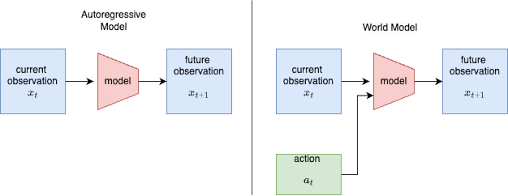
Traditional AI models can perform tasks such as classification, text generation, and pattern recognition. World models focus more specifically on representing environments and predicting how they change.
The distinction is about the model’s purpose, rather than a strict separation between technologies. Some AI systems combine language models, perception models, world models, and planning components.
| Feature | Traditional AI Model | World Model |
|---|---|---|
| Primary purpose | Recognize patterns or generate outputs | Represent an environment and predict changes |
| Typical input | Text, images, audio, or structured data | Observations, actions, and environmental information |
| Main capability | Classification, prediction, or generation | Prediction of possible future states |
| Planning support | Depends on the system | Can help evaluate possible actions |
| Example application | Identifying objects in an image | Predicting how objects may move after an action |
A conventional AI model may recognize a chair in an image. A world model used by a robot could go further by estimating the chair’s position, considering whether it blocks a path, and predicting what might happen if the robot moves around it.
The capabilities of any individual system depend on its design and training.
What Challenges Do World Models Face?
Despite their potential, world models remain an active area of research. Several challenges need to be addressed before their use becomes dependable across a wide range of real-world situations.
Accuracy and Reliability
A model can produce plausible predictions that do not match reality. Small errors may become more significant when a system predicts several steps into the future.
This is particularly important in robotics and autonomous driving, where inaccurate predictions can affect physical safety.
Unfamiliar Situations
AI systems may encounter conditions that differ substantially from their training data. A robot could face an unusual object, while a vehicle could encounter an uncommon road layout.
Models need ways to recognize uncertainty and avoid relying too heavily on predictions they cannot support.
Computational Requirements
Learning and running detailed world models can require substantial computing resources. Systems operating on robots or other devices with limited hardware must balance prediction quality, speed, and energy consumption.
Efficient model design will be important for practical deployment.
The Gap Between Simulation and Reality
A model trained or tested in a simulated environment may struggle with real-world conditions that the simulation does not accurately capture.
Developers must compare predictions with real observations, test systems across diverse scenarios, and update models when significant limitations are identified.
Evaluation and Safety
It can be difficult to determine whether a world model genuinely understands the aspects of an environment needed for a task or simply reproduces familiar patterns.
Researchers need reliable evaluation methods that measure predictive accuracy, robustness, and performance under changing conditions. Safety-critical applications also require independent safeguards beyond the model itself.
What Is the Future of World Models in AI?
World models could become an important part of AI systems that need to interact with complex environments rather than process information alone.
Research may lead to better combinations of perception, prediction, reasoning, and action planning. This could help robots handle more varied tasks, improve simulated training, and support AI applications that must respond to changing physical conditions.
Another promising direction is the integration of world models with other AI technologies. For example, a language model might interpret a human instruction, while a world model helps estimate the consequences of possible actions and a planning system selects an appropriate sequence of steps.
Such combinations could make AI systems more useful in environments where both communication and physical interaction matter.
Still, progress will depend on more than building larger models. Developers will need accurate data, efficient computation, careful evaluation, and reliable methods for managing uncertainty.
The most meaningful advances will come when AI systems can make useful predictions, recognize their limitations, and respond safely when the real world behaves differently from their expectations.
Conclusion
World models in AI represent an important direction in the development of systems that can predict how environments change and evaluate the possible consequences of their actions.
From industrial robots and autonomous vehicles to scientific simulations, these models could help AI move beyond recognizing patterns toward more informed decision-making.
They are not complete representations of reality, and their predictions are not always correct. However, when combined with strong perception, planning, testing, and safety measures, world models offer a promising approach to building AI systems that can operate more effectively in dynamic environments.
As research continues, their role in robotics, simulation, and real-world AI applications will be worth watching.
Frequently Asked Questions
1. What are world models in AI?
World models in AI are internal representations that help machines understand their environments and predict how situations may change over time.
2. How do world models help AI systems?
They help AI systems predict possible outcomes, compare different actions, and make better-informed decisions in changing environments.
3. How are world models used in robotics?
World models can help robots anticipate obstacles, plan movements, navigate unfamiliar spaces, and test actions in simulated environments.
4. What is the difference between world models and language models?
Language models primarily process and generate language, while world models represent environments and predict how they may change.