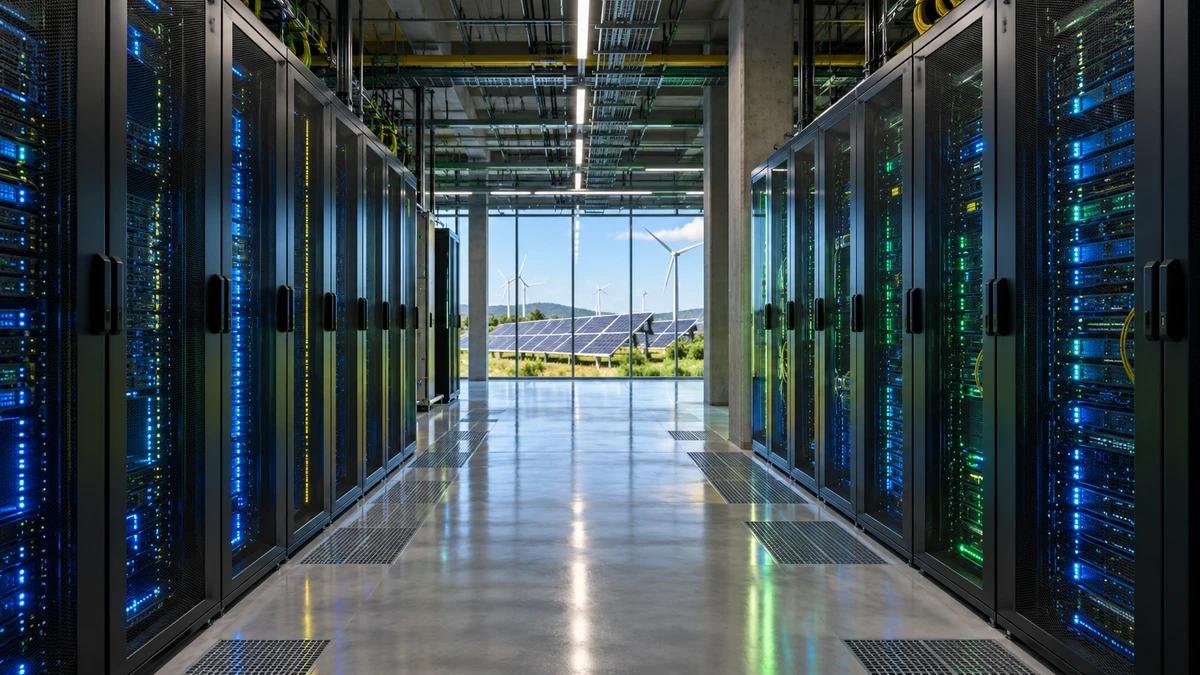
Artificial intelligence is becoming part of everyday life. People use AI assistants to find information, businesses rely on AI to analyze customer behavior, and industries use intelligent systems to automate complex tasks. While these technologies make many activities faster and easier, they also raise an important question: How much energy does artificial intelligence consume?
Behind every AI-generated answer, image, or prediction, computing systems perform calculations that require electricity. Large AI models depend on powerful processors and data centers, which also need cooling systems to maintain safe operating temperatures. As AI adoption continues to grow, its energy requirements deserve greater attention.
The challenge is not simply to reduce AI usage. It is to develop smarter systems that deliver useful results while consuming fewer resources. With better technology, responsible infrastructure, and cleaner energy, artificial intelligence could become more sustainable over time.
Why Does Artificial Intelligence Consume So Much Energy?
AI systems require computing power to process information, identify patterns, and generate responses. The amount of energy used depends on the model’s size, the complexity of the task, the hardware involved, and how frequently the system operates.
1. Training Large AI Models
Training an AI model involves processing enormous amounts of data and repeatedly adjusting its internal parameters. This process can require thousands of powerful processors running for extended periods.
Larger models often need more computing resources, although the actual energy requirement varies considerably between systems. Training is only one part of the picture, but it can represent a significant energy demand for advanced models.
2. Everyday AI Usage
Once a model has been trained, it still requires electricity whenever someone uses it. This stage is commonly called inference.
A single request may consume relatively little energy, depending on the model and task. However, millions of requests from users, applications, and businesses can create substantial demand when combined.
AI-powered search, content generation, virtual assistants, and image processing all depend on computing infrastructure that must remain available to serve users.
3. Data Center Cooling
AI processors generate heat while working. Data centers must remove this heat to prevent equipment from overheating and to maintain reliable performance.
Cooling equipment, ventilation, networking devices, and other supporting systems also use electricity. As AI workloads become more demanding, data center operators need efficient ways to manage both computing and cooling requirements.
How Does AI Energy Consumption Affect the Environment?
The environmental impact of AI depends partly on how the electricity powering its infrastructure is produced. When data centers rely on electricity generated from fossil fuels, their operations can contribute to greenhouse gas emissions.
Water consumption is another consideration. Some data centers use water-based cooling systems, and electricity generation can also require water. The amount depends on the location, cooling technology, climate, and energy source.
There are also environmental costs associated with manufacturing AI hardware. Producing advanced processors, constructing data centers, and replacing equipment require materials, energy, and industrial resources.
These impacts do not mean that AI should be avoided altogether. They highlight the importance of measuring its full environmental footprint rather than looking only at the electricity used by individual computers.
Can Artificial Intelligence Become More Energy Efficient?
Yes. AI can become more energy efficient through improvements in software, hardware, and infrastructure. Several approaches are already helping organizations explore ways to reduce unnecessary computing demand.
1. Developing Smaller and More Efficient Models
Bigger models are not always necessary for every task. A compact AI model may be sufficient for classifying documents, answering routine questions, or detecting specific patterns.
Developers can use model compression, quantization, and other optimization techniques to reduce computing requirements while preserving useful performance. Choosing the right model for each task can help organizations avoid using more resources than necessary.
2. Using Energy-Efficient Hardware
AI workloads depend heavily on the processors that execute them. Modern AI accelerators can perform certain calculations more efficiently than older or less suitable hardware.
Improved chip design, better memory management, and efficient data movement can also reduce the energy required for particular workloads. Hardware improvements are most valuable when combined with software designed to take advantage of them.
3. Powering Data Centers With Cleaner Energy
The electricity source matters as much as computing efficiency. Data centers can reduce operational emissions by using renewable electricity from sources such as solar and wind.
Energy storage, improved grid management, and careful workload scheduling can help make better use of cleaner power. However, renewable energy availability varies by location and time, so organizations need to consider when and where electricity is consumed.
4. Improving Cooling Systems
Efficient cooling can reduce the additional energy required to operate AI infrastructure. Depending on the facility, options include liquid cooling, improved airflow management, and systems that adjust cooling according to actual equipment demand.
Operators can also use local climate conditions and real-time monitoring to manage temperature more effectively. The best approach depends on the facility’s design, hardware, and operating environment.
5. Measuring Energy Use During AI Development
AI developers can track the computing time, electricity consumption, and emissions associated with their workloads. This information helps teams compare models and identify opportunities for improvement.
Measurement also supports more informed decisions. Instead of choosing a model based only on speed or accuracy, organizations can consider its energy requirements alongside performance and cost.
How Can AI Help Solve Environmental Problems?
Artificial intelligence is not only a consumer of energy. It can also support environmental improvements when applied carefully.
Smarter electricity grids: AI can help forecast electricity demand, identify unusual grid conditions, and improve the integration of variable renewable energy.
Industrial energy optimization: Factories can use AI to identify inefficient equipment, improve production schedules, and reduce unnecessary energy consumption.
Building management: Intelligent control systems can adjust heating, cooling, and lighting based on occupancy and operating conditions.
Renewable energy forecasting: AI models can analyze weather patterns to estimate solar and wind power generation, helping energy providers plan their operations.
Predictive maintenance: AI can identify signs of equipment deterioration before major failures occur, potentially reducing downtime, material waste, and inefficient operation.
These applications show that AI can contribute to sustainability. However, the environmental benefit should be measured against the energy and resources required to develop, deploy, and operate the system.
What Challenges Could Slow the Move Toward Sustainable AI?
Making AI more sustainable involves more than improving individual models.
One challenge is growing demand. Even if each AI task becomes more efficient, the total amount of computing may increase as more people and businesses adopt the technology. This means efficiency gains do not automatically guarantee lower overall energy consumption.
Another challenge is transparency. Energy use varies across models, data centers, hardware configurations, and electricity sources. Without consistent reporting, it can be difficult to compare the environmental impact of different AI systems fairly.
Organizations must also balance efficiency with reliability, privacy, cost, and model performance. In some cases, reducing energy use may require redesigning applications or changing how a service is delivered.
Finally, sustainable AI requires cooperation among developers, hardware manufacturers, cloud providers, energy companies, policymakers, and users. No single improvement can address every part of the problem.
What Can Businesses Do to Make AI More Sustainable?
Businesses do not need to stop using AI to improve their environmental performance. They can begin by making more deliberate technology choices.
- Select appropriate models: Use smaller models for straightforward tasks when they meet the required accuracy and reliability standards.
- Remove unnecessary workloads: Review automated processes and eliminate repeated calculations that do not provide meaningful value.
- Monitor computing resources: Track electricity consumption, hardware utilization, and workload performance where reliable measurements are available.
- Choose infrastructure carefully: Consider energy efficiency, electricity sources, and environmental reporting when selecting cloud or data center providers.
- Set measurable goals: Establish practical targets for reducing energy use per task or improving computing efficiency.
- Evaluate real benefits: Confirm that AI applications deliver meaningful improvements rather than adding computing demand without a clear purpose.
These steps can help businesses make AI adoption more responsible while maintaining the benefits of automation and data-driven decision-making.
The Future of Sustainable Artificial Intelligence
The future of AI will depend not only on how capable these systems become, but also on how efficiently they operate. Researchers are exploring more efficient algorithms, specialized processors, improved cooling technologies, and methods for reducing the computing resources required by AI models.
At the same time, organizations are paying greater attention to energy reporting and the environmental effects of digital infrastructure. Better measurement could help developers understand which improvements deliver the greatest benefits.
There is no single solution that will make every AI system sustainable. Progress will require a combination of technical innovation, cleaner electricity, responsible deployment, and transparent reporting.
The most useful question is therefore not whether AI should consume energy at all. Computing will always require resources. The more important question is whether each AI application creates enough value to justify the resources it uses—and whether the same result can be achieved more efficiently.
Conclusion
Artificial intelligence has enormous potential, but its growing energy requirements cannot be ignored. Training advanced models, serving everyday requests, and maintaining data center infrastructure all contribute to its environmental footprint.
Fortunately, more efficient models, improved hardware, cleaner electricity, smarter cooling, and better workload management can help reduce the impact. AI can also support energy optimization and environmental monitoring in other industries.
A sustainable AI future will depend on balancing technological progress with responsible resource use. By prioritizing efficiency and measuring real environmental outcomes, developers and businesses can help ensure that artificial intelligence becomes not only more powerful, but also more responsible.
Frequently Asked Questions
1. Why does artificial intelligence consume so much energy?
Artificial intelligence consumes energy because training and running AI models require powerful processors and data centers. Cooling systems and supporting equipment also contribute to overall electricity consumption.
2. Can AI become more environmentally sustainable?
Yes, AI can become more sustainable through energy-efficient hardware, smaller optimized models, renewable electricity, improved cooling systems, and better management of computing resources.
3. How does AI energy consumption affect the environment?
AI energy consumption can contribute to greenhouse gas emissions when electricity comes from fossil fuels. Data centers may also use water for cooling, while manufacturing AI hardware requires materials and energy.
4. How can businesses reduce AI energy consumption?
Businesses can select efficient AI models, eliminate unnecessary computing tasks, monitor energy use, choose data centers powered by cleaner electricity, and measure the environmental impact of their AI applications.