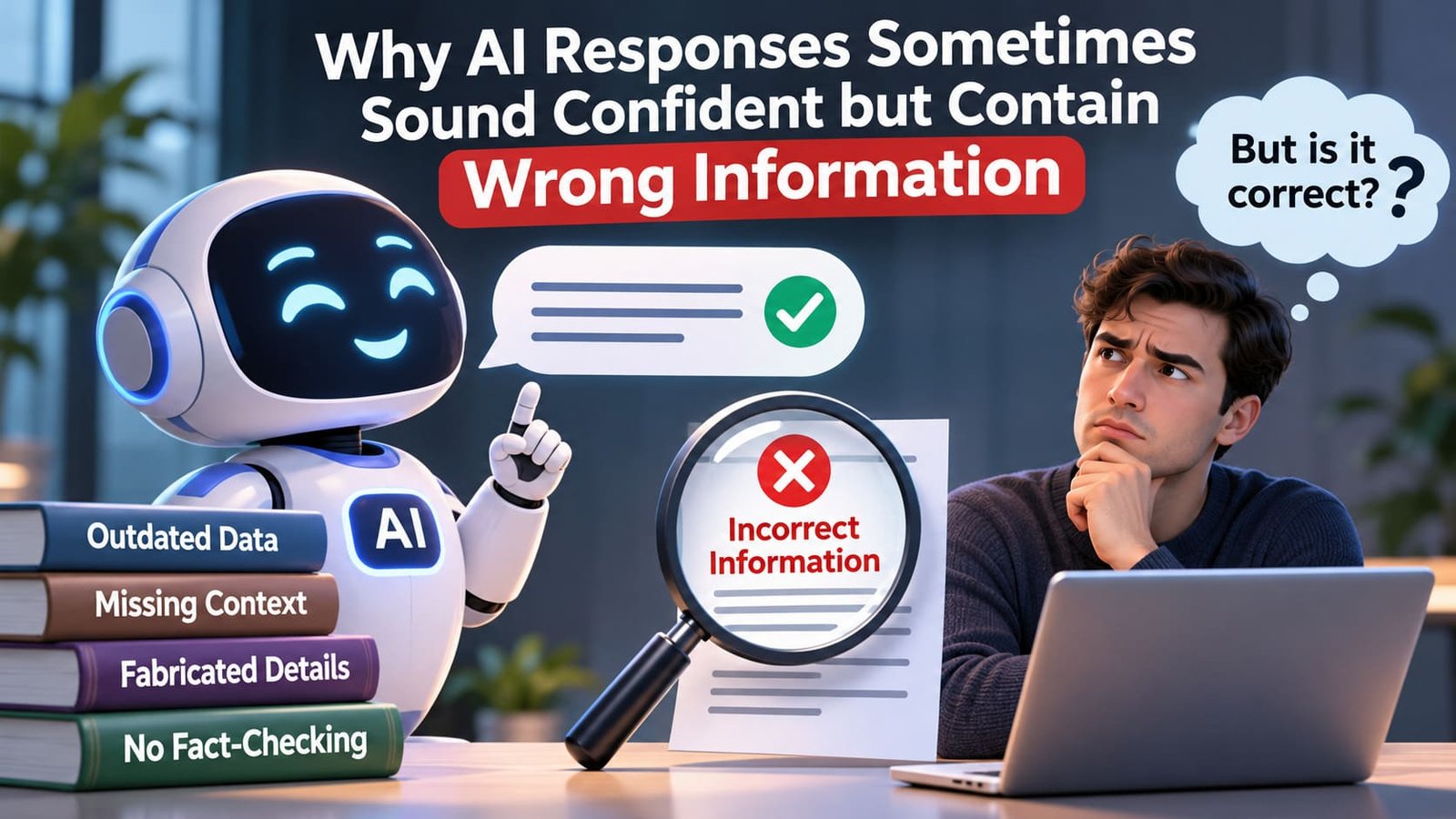
Artificial intelligence has become a regular part of how people search for information, write content, solve problems, and make everyday decisions. From answering technical questions to explaining complicated subjects, AI tools can deliver responses within seconds. Their ability to communicate in clear, well-organized language makes them particularly useful.
However, there is something users should understand before relying on these answers: a confident AI response is not always a correct one.
You might ask an AI chatbot about a technology, a historical event, a business fact, or a scientific concept and receive an answer that sounds completely convincing. It may include detailed explanations, specific dates, professional terminology, and even references. Yet, after checking the information, you may discover that some details are inaccurate or entirely made up.
This behaviour is commonly known as an AI hallucination.
The problem is not simply that AI makes mistakes. The bigger concern is that it sometimes presents incorrect information in a way that makes it difficult for users to recognise those mistakes.
As AI adoption continues to grow in 2026, understanding why this happens has become increasingly important. Let’s explore what happens behind these responses, why AI systems struggle with factual accuracy, and how users can approach AI-generated information more carefully.
What Does It Mean When AI Gives a Confident but Incorrect Answer?
An AI hallucination occurs when an artificial intelligence system generates information that sounds reasonable but is factually incorrect, unsupported, or completely fabricated.
For example, imagine asking an AI tool to explain a software feature that was introduced recently. Instead of admitting that it does not have enough information, the system might describe a feature that does not exist or provide instructions based on an older version of the software.
The explanation may look professional and technically accurate at first glance.
This happens because AI systems are designed to generate meaningful language based on patterns learned during training. They do not automatically verify every statement against a trusted source before presenting it.
As a result, an answer can be grammatically correct, logically structured, and still contain incorrect information.
Why Do AI Systems Sometimes Generate Incorrect Information?
There is no single reason behind AI hallucinations. Several technical and training-related factors can influence how an AI system produces its answers.
1. AI Predicts Language Rather Than Automatically Verifying Facts
Large language models work by predicting what words or pieces of text are likely to come next based on the context of a conversation.
During training, these models learn patterns from enormous collections of text, including articles, books, websites, and other information sources.
This allows them to generate natural and relevant responses. However, predicting a likely sentence is different from confirming whether every statement in that sentence is true.
For instance, when asked about an unfamiliar company or a lesser-known technical term, an AI model may generate an explanation that resembles information it has encountered during training, even when the specific details are incorrect.
This is one of the fundamental reasons why fluent AI-generated answers should not automatically be treated as verified information.
2. Outdated Information Can Affect the Accuracy of Responses
Technology, business regulations, software platforms, and scientific research change continuously.
An AI model may have been trained on information that was accurate at a particular point in time but is no longer relevant.
Consider someone asking about the latest cybersecurity regulations, a newly released software update, or recent developments in artificial intelligence.
If the AI system cannot access current information, it may provide an answer based on older knowledge.
The response might have been correct several months or years ago, but that does not necessarily make it accurate today.
In 2026, this limitation matters because many industries are experiencing rapid changes. Users should check publication dates and consult current official documentation whenever the answer depends on recent developments.
3. Missing Context Can Lead to Incorrect Assumptions
AI tools depend heavily on the information included in a user’s question.
Sometimes, a question does not contain enough detail to identify the exact situation. Instead of asking for clarification, an AI system may interpret the request in a particular way and build its response around that assumption.
For example, asking “Is this software secure?” does not provide enough context.
The answer could depend on the software version, security configuration, hosting environment, authentication methods, and intended usage.
Without these details, an AI-generated response may make broad assumptions that do not apply to the user’s actual situation.
Providing specific context can reduce misunderstandings, although it cannot guarantee a completely accurate answer.
4. AI Can Generate Details That Sound Real but Do Not Exist
One particularly concerning issue is the creation of fabricated information.
An AI system may generate:
- Research papers that were never published.
- Statistics without reliable supporting evidence.
- Incorrect website references.
- Non-existent software features.
- Misleading quotations attributed to real individuals.
- Incorrect dates, names, and technical specifications.
These details can be especially difficult to identify because they are often presented in a professional format.
For example, an AI tool might provide a research citation containing an author’s name, publication title, and year. However, when someone searches for the publication, they may discover that the reference does not exist.
This is why important references should always be checked against the original publication or an authoritative source.
5. Training and Evaluation Can Encourage Guessing
Another important factor is how AI models are trained and evaluated.
Historically, many AI evaluations have focused heavily on whether a model produces the correct answer. However, if a system receives more credit for attempting an answer than for acknowledging uncertainty, it may be encouraged to guess when information is incomplete.
Research published by OpenAI in September 2025 discussed how standard evaluation methods can reward guessing rather than admitting uncertainty.
A related study published in Nature in April 2026 examined how accuracy-focused evaluations can incentivise hallucinations.
This highlights an important distinction: a reliable AI system should not only provide correct answers but should also recognise situations where it lacks sufficient evidence.
Why Do Confident AI Responses Mislead Users?
The way AI communicates plays a significant role in how people interpret its answers.
People naturally associate clear explanations, detailed descriptions, and professional language with knowledge and expertise.
AI systems can reproduce these communication patterns very effectively.
Consider two responses to the same question:
Response A: “I am not certain about this information. It would be better to check the latest official documentation.”
Response B: “This feature was introduced in the latest version and is fully supported across all compatible systems.”
The second response sounds more authoritative. However, if the information is incorrect, its confident wording can make the mistake harder to recognise.
Research from UC Berkeley Haas, published in October 2026, reported that 11 leading large language models expressed an average confidence of 88% while answering correctly 79% of the time in the study.
This illustrates why confidence and factual accuracy should be treated as two different things.
Users should evaluate the evidence behind an answer rather than judging its reliability by how confidently it is written.
How Can Users Identify Incorrect AI-Generated Information?
Recognising potentially inaccurate AI responses does not require advanced technical knowledge. A few practical habits can make a meaningful difference.
Verify Important Facts
Whenever an AI response includes specific dates, statistics, technical claims, or legal information, check those details through reliable sources.
Official websites, government portals, research publications, and product documentation are useful starting points.
Check the Original Sources
If an AI tool provides a reference, open the actual source rather than relying on the citation text.
Confirm that the publication exists and that it genuinely supports the statement being made.
Be Careful With Very Specific Answers
An answer containing exact numbers, technical specifications, or detailed explanations is not automatically more reliable.
Specific details should receive additional attention, particularly when the AI system has not provided supporting evidence.
Ask AI to Explain Its Limitations
Users can improve the quality of an interaction by asking questions such as:
- Which parts of this answer are verified?
- Are there any assumptions in this explanation?
- Can you provide reliable sources for these claims?
- Is this information current?
- What details are you uncertain about?
These questions encourage a more careful response, although the answers still need independent verification.
Use Multiple Reliable Sources
For important decisions, compare AI-generated information with more than one credible source.
If several independent sources support the same information, confidence in the conclusion becomes stronger. However, simply receiving the same answer from multiple AI tools does not guarantee that it is correct.
How Are AI Developers Working to Reduce Hallucinations in 2026?
AI reliability has become an important area of research and development.
Developers are exploring different techniques to reduce fabricated information and improve how models communicate uncertainty.
Some important approaches include:
1. Retrieval-Augmented Generation (RAG)
RAG allows AI systems to retrieve relevant information from external documents or knowledge sources before generating a response. This can help connect answers to more specific and current information.
2. Improved Uncertainty Detection
Researchers are working on methods that help AI systems recognise when they may not have enough information to answer a question accurately.
3. Source-Based Responses
Connecting generated answers with supporting documents, research papers, and official references makes it easier for users to verify important claims.
4. Better Model Evaluation
AI developers are exploring evaluation methods that consider not only answer accuracy but also whether a model appropriately acknowledges uncertainty.
5. Human Review
In sensitive areas such as healthcare, finance, legal services, and cybersecurity, human expertise remains important. AI-generated recommendations should not replace qualified professional judgement.
These developments are improving the reliability of AI systems, but hallucinations remain an active research challenge rather than a completely solved problem.
Can AI Ever Become 100% Accurate?
Achieving complete factual accuracy across every possible question is extremely difficult.
Information changes, some questions have incomplete evidence, and certain subjects involve uncertainty or different interpretations.
Even advanced AI models can misunderstand a question, rely on incomplete context, or generate unsupported details.
The goal should therefore be to develop AI systems that are not only more accurate but also more transparent about their limitations.
A trustworthy AI tool should be capable of recognising when it knows something, when it needs additional information, and when it should avoid making unsupported claims.
This approach can help build a healthier relationship between human users and artificial intelligence.
Conclusion
AI has made accessing information faster and more convenient, but speed should never be confused with accuracy.
A well-written response can still contain incorrect facts, fabricated references, or outdated information. The challenge becomes even greater when users assume that confident language means the system has verified its answer.
As artificial intelligence becomes more deeply integrated into everyday activities, understanding its limitations is just as important as learning how to use it.
The best approach is not to avoid AI-generated information altogether. Instead, use AI as a helpful starting point, verify important claims, consult reliable sources, and apply human judgement before making decisions.
Frequently Asked Questions
1. Why does AI sometimes provide incorrect information confidently?
AI sometimes provides incorrect information confidently because it generates responses based on learned language patterns rather than automatically verifying every fact. This can result in convincing answers that contain outdated, incomplete, or fabricated details.
2. What are AI hallucinations?
AI hallucinations occur when an artificial intelligence system generates information that sounds realistic but is factually incorrect or unsupported. Examples include fake research references, incorrect statistics, and non-existent technical features.
3. How can users identify incorrect AI-generated information?
Users can identify potentially incorrect AI-generated information by checking facts against trusted websites, reviewing original research sources, verifying statistics, and comparing important details with official documentation.
4. Can AI hallucinations be completely eliminated?
AI hallucinations cannot currently be completely eliminated. However, techniques such as retrieval-augmented generation, improved model evaluation, uncertainty detection, and human verification can help reduce inaccurate responses.