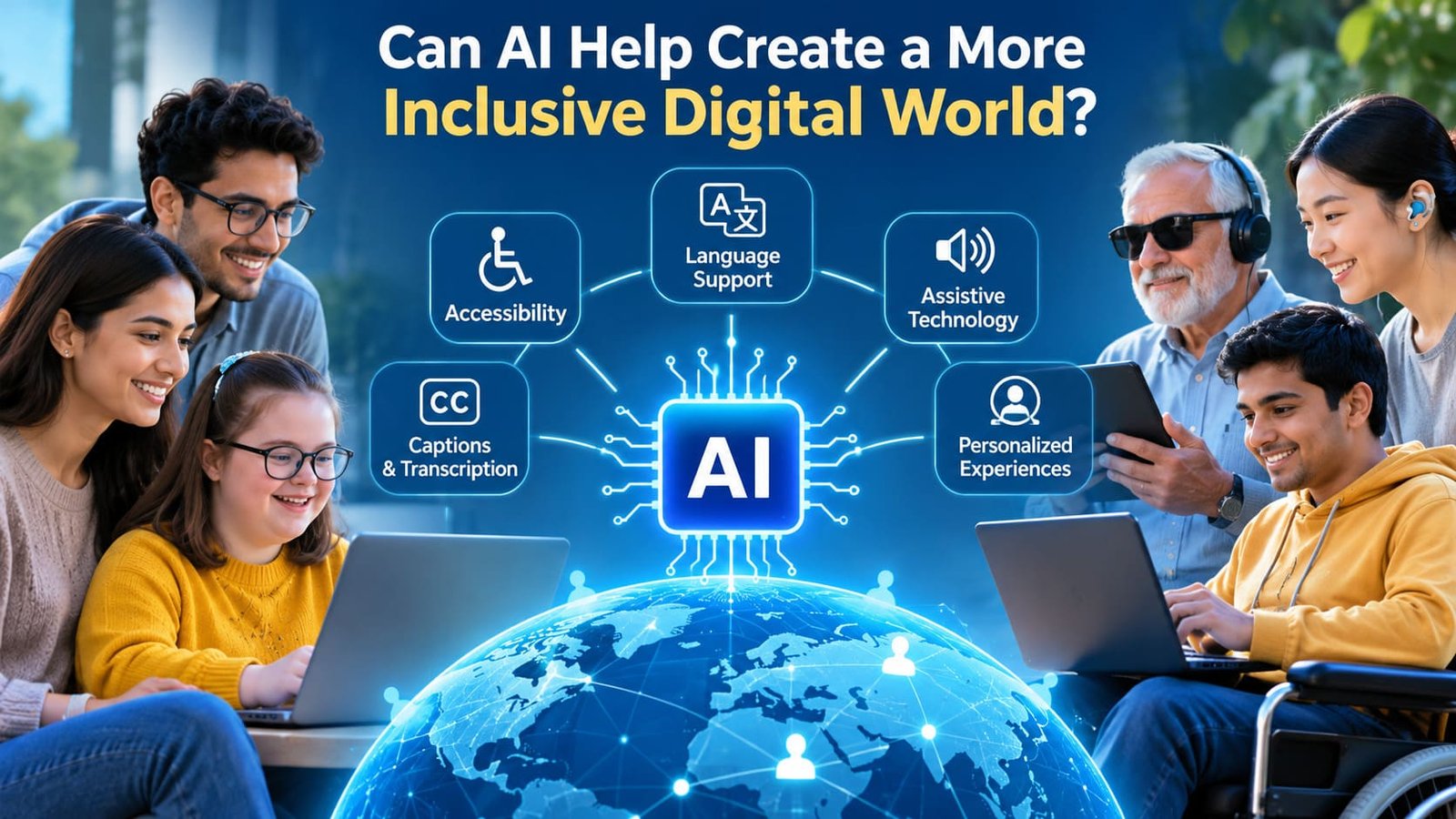
Technology has made it easier to stay connected, access information, learn new skills, and complete everyday tasks. With just a smartphone or computer, people can communicate across countries, attend online classes, manage businesses, and access services from almost anywhere.
But there is another side to this progress that deserves attention. Not everyone can use digital technology with the same level of comfort.
A person with a visual impairment may struggle to understand an image without a description. Someone who speaks a regional language may find it difficult to follow information available only in English. Even a simple online form can become frustrating for someone who finds complicated digital interfaces difficult to navigate.
These experiences reveal an important gap in technological development. While digital platforms are becoming more advanced, they are not always becoming easier for everyone to use.
Artificial Intelligence (AI) could help change that. Instead of expecting every individual to interact with technology in the same way, AI offers opportunities to create digital experiences that respond to different human needs.
The interesting question is not simply whether AI can make technology smarter. It is whether it can make technology more welcoming, understandable, and accessible to everyone.
The Digital World Is Not Equally Comfortable for Everyone
Most digital products are designed around a particular idea of how people use technology. Users are expected to read text, understand visual information, listen to audio, and navigate menus using familiar devices.
However, real-life experiences are much more varied.
Some people depend on screen readers to understand website content. Others need subtitles to follow online videos. People with limited mobility may prefer voice-based controls, while users with different language backgrounds may need translated information.
When these requirements are overlooked, digital services can unintentionally exclude the very people they are supposed to help.
This is why digital inclusion matters. It means creating an environment where people can access information and participate in online activities without unnecessary barriers.
AI provides an opportunity to approach this challenge differently by making certain digital functions more adaptable.
How AI Can Change the Way People Experience Technology
1. Making Online Information Easier to Access
Imagine opening an educational website and finding an important diagram that explains a complicated topic. For someone who cannot see the image clearly, that information may be completely inaccessible.
AI-powered image recognition can help by generating descriptions of visual content. Similarly, text-to-speech technology can turn written information into spoken words, allowing people to listen instead of reading everything on a screen.
Another useful example is automatic captioning. People watching videos can follow conversations through on-screen text, even when listening to audio is difficult or inconvenient.
These technologies may seem like small improvements, but they can change how independently someone accesses digital information.
The bigger opportunity is to ensure that useful information is available through more than one format.
2. Making Language Differences Less Restrictive
A language barrier can prevent someone from accessing opportunities even when the required information is freely available online.
Consider a small business owner who wants to understand an international market but struggles with English-language reports. Or a student who finds a useful online course but cannot comfortably understand the language used in its lessons.
AI translation tools can help bridge these gaps by converting written and spoken information into supported languages.
Speech recognition and conversational AI can also make communication more convenient for people who prefer speaking rather than typing.
This is particularly valuable in multilingual countries such as India, where people regularly communicate in different regional languages.
However, translation must go beyond converting individual words. Local expressions, cultural context, and regional accents also matter. AI developers need to improve these areas to make language support genuinely useful.
3. Giving People Different Ways to Interact With Digital Devices
Technology should not force everyone to use a keyboard, mouse, or touchscreen in exactly the same way.
For someone with limited mobility, typing a long message or navigating multiple menus can be difficult. Voice-based applications provide another way to perform certain activities.
AI-powered speech recognition allows users to dictate messages, search for information, and control supported applications through spoken instructions.
Similarly, people who have difficulty reading lengthy content can use tools that convert text into audio or help explain complicated information.
The real benefit is the freedom to choose how to interact with technology.
An inclusive digital experience should offer alternatives rather than making one method compulsory for everyone.
4. Making Online Learning More Adaptable
Not every student learns at the same speed or understands information through the same teaching method.
Some students need additional explanations, while others benefit from examples, visual materials, or audio support.
AI-powered learning applications can help provide these alternatives. They can explain difficult subjects in simpler language, translate learning materials, and offer additional practice based on a student’s progress.
For example, a student who struggles with a technical concept may use an AI learning assistant to understand it through a practical example rather than reading another complicated explanation.
This does not mean AI should replace teachers. Human guidance remains essential for understanding individual difficulties, encouraging students, and providing meaningful feedback.
Instead, AI can serve as an additional learning resource that makes education more flexible.
5. Helping Create More Accessible Workplaces
Digital inclusion also has an important place in professional environments.
Employees may have different communication preferences, physical abilities, and accessibility requirements. Traditional workplace systems do not always accommodate these differences.
AI tools can support workplace accessibility through meeting transcription, speech-to-text applications, document assistance, and translation features.
For instance, an employee who cannot easily follow a spoken meeting can refer to its written transcript. Someone working with an international team can use translation tools to understand discussions more comfortably.
These applications can reduce communication difficulties and support greater participation.
Businesses should recognize that accessibility is not simply a technical requirement. It is also an important part of creating an environment where employees can contribute effectively.
What Happens When AI Itself Becomes a Barrier?
AI has the potential to improve accessibility, but it is not automatically fair or reliable.
There are situations where poorly designed AI systems can create new difficulties instead of solving existing ones.
Consider a speech recognition system that understands certain accents accurately but regularly misunderstands others. For the people affected, a feature designed to improve accessibility may become another frustrating obstacle.
There are several other concerns worth considering.
Lack of diverse training data: AI systems may not perform equally well for people from different communities, language groups, and backgrounds.
Privacy and personal information: Voice assistants, image recognition applications, and other accessibility tools may process personal data. Protecting that information is essential.
Unequal access to technology: Advanced AI applications may require modern devices, reliable internet connections, and paid subscriptions that are not available to everyone.
Incorrect automated results: AI-generated translations, captions, and image descriptions can contain mistakes that affect a person’s understanding of important information.
Insufficient user involvement: Developers may build features without properly understanding the challenges experienced by the people who need them.
These concerns show why accessibility cannot depend on AI alone. Every solution needs proper testing, human feedback, and responsible development.
Why Inclusive Technology Needs a Human Perspective
One important mistake businesses can make is assuming that adding AI automatically makes a product more accessible.
A feature may work perfectly during a demonstration but fail when someone uses it in a real situation.
For example, an automatic captioning tool might struggle with background noise, unfamiliar accents, or multiple people speaking simultaneously. A website may offer text-to-speech functionality but still have navigation problems that make the overall experience difficult.
This is why people with different accessibility requirements should be involved in product development and testing.
Their experiences can help developers identify problems that may not be visible during technical testing.
Businesses should also follow established accessibility practices, provide alternative ways to access information, and allow users to control the features they depend on.
AI can make technology more adaptable, but understanding people is what makes that technology meaningful.
What Should Businesses Do to Build a More Inclusive Digital Experience?
Businesses developing websites, applications, and digital services have an opportunity to make inclusion part of their everyday development process.
Instead of waiting for accessibility complaints, they can take practical steps from the beginning:
- Design for different users: Consider different abilities, languages, and levels of technical knowledge during product development.
- Provide alternative formats: Make important information available through readable text, captions, audio, and accessible descriptions.
- Improve website navigation: Support keyboard navigation, screen readers, and clear website structures.
- Test with real users: Collect feedback from people with different accessibility requirements.
- Use AI responsibly: Review automated results and protect personal information.
- Keep accessibility improving: Regularly identify and correct problems as digital platforms evolve.
These improvements can benefit a much wider audience than businesses might initially expect.
After all, captions are useful in noisy environments, voice commands can save time, and simple website navigation makes browsing easier for almost everyone.
A More Inclusive Digital Future Begins With Better Decisions
The future of digital inclusion will not depend on one particular AI application. It will develop through many small improvements in how technology is designed, tested, and used.
We may see more accurate multilingual communication, better assistive applications, improved voice interfaces, and learning platforms that respond to individual requirements.
But the real measure of progress will be different.
It will be the student who can finally understand an online lesson in a familiar language. It will be the employee who can participate in a meeting through accessible communication tools. It will be the individual who can independently use a digital service that previously felt difficult to navigate.
These are the kinds of everyday improvements that give technological development a meaningful purpose.
AI should not create a digital world that works only for people who already know how to use technology. It should help make that world easier to access for people who experience it differently.
Conclusion
Can AI help create a more inclusive digital world? Absolutely, but its success depends on how thoughtfully it is developed and applied.
From accessible communication and multilingual support to personalized learning and workplace assistance, AI is creating new ways for people to participate in digital activities.
However, real inclusion requires more than intelligent software. It needs accessible design, reliable technology, privacy protection, and a genuine understanding of different human experiences.
Technology should never become another barrier that people have to overcome.
Frequently Asked Questions
Q1. How can AI help create a more inclusive digital world?
AI makes digital platforms more accessible through voice recognition, automatic captions, language translation, and personalized tools.
Q2. How does AI help people with disabilities?
AI tools can read text aloud, describe images, convert speech into text, and provide alternative ways to use digital devices.
Q3. What are the challenges of using AI for digital inclusion?
AI bias, privacy concerns, limited internet access, inaccurate translations, and insufficient regional language support are major challenges.
Q4. Can AI completely replace human involvement in digital accessibility?
No. Human feedback, accessible design, and proper testing are still essential to ensure technology meets everyone’s needs.