Energy consumption is becoming a major challenge for businesses, cities, and households. As digital services expand, factories become more automated, and artificial intelligence adoption grows, the demand for electricity continues to increase. At the same time, organizations are looking for smarter ways to reduce energy waste, control operating costs, and meet sustainability goals.
This is where AI energy optimization is making a difference.
Artificial intelligence can analyze energy usage, identify inefficient patterns, predict future demand, and recommend adjustments that help systems operate more efficiently. Instead of relying entirely on fixed schedules or manual monitoring, organizations can use intelligent systems to make decisions based on real-time conditions.
From automatically adjusting building temperatures to improving data center cooling, AI is creating new opportunities to manage electricity more intelligently. However, its effectiveness depends on the quality of available data, the systems being monitored, and how well the technology is implemented.
What Is AI Energy Optimization?
AI energy optimization refers to the use of artificial intelligence and machine learning to monitor, analyze, and improve how energy is consumed.
Traditional energy management often relies on predefined rules, periodic inspections, and historical electricity bills. These methods can identify some problems, but they may overlook changes that happen throughout the day.
AI-based systems can process information from smart meters, connected sensors, equipment controllers, weather forecasts, and building management platforms. By analyzing these inputs, they can recognize consumption patterns and identify opportunities to reduce unnecessary electricity use.
For example, an intelligent building management system may discover that certain rooms are being cooled even when they are unoccupied. It can use occupancy information and temperature readings to adjust heating, ventilation, and air conditioning according to actual requirements.
The objective is not simply to use less electricity at all times. It is to use energy when and where it is needed, while maintaining safety, comfort, productivity, and reliable performance.
How AI Helps Reduce Power Consumption
1. Predicting Energy Demand
One of the most useful applications of AI is energy demand forecasting.
Electricity requirements can change significantly depending on weather, production schedules, business activity, and consumer behavior. Machine learning models can analyze historical consumption alongside these variables to estimate future demand.
For instance, a commercial building may experience higher electricity usage during particularly hot afternoons. By identifying this pattern, an AI system can help facility managers prepare cooling equipment in advance and avoid unnecessary peak demand.
Accurate forecasts also help utilities balance electricity supply and demand more effectively. Although predictions are not always perfect, better forecasting can support more informed operational decisions.
2. Improving Data Center Efficiency
Data centers require electricity to power servers, networking equipment, storage systems, and cooling infrastructure. As AI applications and cloud computing expand, managing this energy demand is becoming increasingly important.
AI can analyze server utilization, temperature readings, airflow, and cooling requirements to identify inefficiencies. Depending on the infrastructure, intelligent controls may adjust cooling settings, distribute workloads, or identify equipment that is consuming more power than expected.
For example, if a group of servers generates less heat during certain periods, an optimized cooling system may reduce cooling output where conditions safely allow it.
These adjustments must respect equipment temperature limits, reliability requirements, and cybersecurity controls. AI does not automatically make every data center more efficient, but carefully implemented systems can help operators identify and address energy waste.
3. Making Buildings Smarter
Buildings are another important area for AI-powered energy management. Lighting, heating, cooling, elevators, and other systems contribute to a facility’s total electricity consumption.
AI can combine occupancy sensors, weather information, indoor temperature measurements, and historical usage to improve how these systems operate.
Consider an office where employees arrive at different times and use different meeting rooms throughout the day. A conventional system might run the same lighting and cooling schedule regardless of occupancy. An intelligent system can adjust settings to match actual usage while preserving comfortable working conditions.
Over time, these adjustments can reduce unnecessary energy consumption without requiring occupants to manage every device manually.
4. Optimizing Industrial Operations
Manufacturing facilities often operate energy-intensive machinery, compressors, pumps, motors, and production lines. Even small inefficiencies can become significant when equipment runs continuously.
AI systems can study machine performance, production output, maintenance records, and electricity consumption to identify unusual patterns.
For example, an industrial motor that consumes more electricity than expected for a particular workload may indicate a maintenance issue or inefficient operating condition. An AI-powered monitoring platform can flag the change for investigation.
Predictive maintenance can also help prevent equipment deterioration that leads to inefficient operation. However, recommendations should be reviewed against engineering requirements before equipment settings are changed.
5. Supporting Renewable Energy and Smart Grids
Solar and wind generation depend on environmental conditions, making their output variable. AI can help energy operators forecast renewable generation and coordinate available electricity with expected demand.
When combined with smart meters, energy storage, and grid management systems, intelligent forecasting can support better decisions about when to store electricity, use available renewable power, or shift flexible consumption to another period.
For example, a commercial facility with battery storage may use solar generation during the day to charge its battery and draw on stored energy during a more expensive evening period, depending on its tariff and operating requirements.
AI can help evaluate these decisions, but the actual benefit depends on battery efficiency, weather conditions, electricity pricing, and the site’s energy needs.
Real-World Applications of AI Energy Optimization
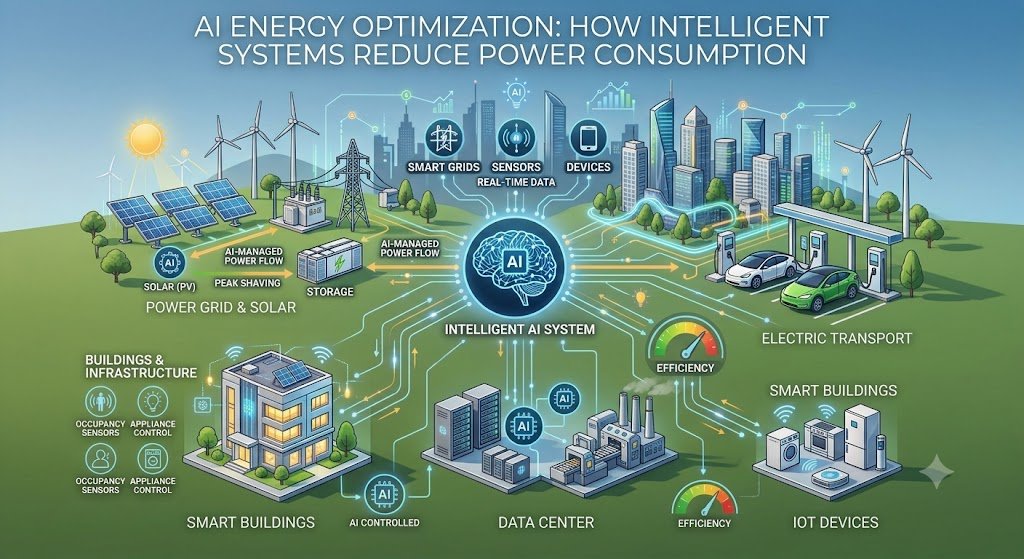
AI energy optimization is not limited to a single industry. Its applications vary according to the equipment, available data, and operational objectives.
- Commercial offices: Adjusting lighting and cooling based on occupancy and weather.
- Data centers: Coordinating cooling, monitoring server workloads, and identifying energy inefficiencies.
- Manufacturing plants: Detecting abnormal electricity usage and supporting predictive maintenance.
- Electricity providers: Forecasting demand and renewable generation to support grid planning.
- Smart homes: Learning usage patterns and coordinating compatible thermostats, appliances, and energy storage.
- Electric vehicle charging: Scheduling flexible charging around grid capacity, energy availability, and electricity tariffs.
These applications demonstrate how AI can turn energy data into useful operational insights. The strongest results generally come when intelligent software is integrated with reliable sensors, suitable equipment, and clear energy management goals.
Benefits of AI-Powered Energy Management
Lower Operating Costs
Reducing unnecessary electricity consumption can help organizations control operating expenses. In some markets, shifting flexible usage away from expensive peak periods may provide additional savings.
Better Energy Visibility
AI-powered dashboards can help teams understand when, where, and why electricity is being consumed. This visibility makes it easier to investigate unexpected increases and prioritize improvements.
Improved Equipment Performance
Monitoring equipment continuously can reveal abnormal operating conditions before they become more serious problems. This may support maintenance planning and help avoid energy waste caused by poorly performing machinery.
Support for Sustainability Goals
Using electricity more efficiently can reduce associated emissions, particularly where electricity generation relies on fossil fuels. The environmental benefit depends on the energy source, the timing of consumption, and the resources required to operate the AI system itself.
More Flexible Energy Planning
Forecasting and intelligent controls can help organizations coordinate electricity demand, renewable generation, storage, and production schedules more effectively.
Challenges and Limitations
Despite its potential, AI energy optimization is not a universal solution.
Data quality: Inaccurate sensor readings, missing records, or disconnected systems can lead to unreliable recommendations.
Implementation costs: Sensors, software integration, equipment upgrades, and specialist support may require significant upfront investment.
Cybersecurity and privacy: Connected energy systems can introduce security risks. Organizations need suitable access controls, network protection, and data governance.
Integration with existing equipment: Older buildings and industrial facilities may lack the sensors or control interfaces needed for advanced optimization.
Energy used by AI itself: Training and operating AI models requires computing resources and electricity. The energy savings from an AI system should be assessed against its own energy requirements and other implementation costs.
Human oversight: Automated adjustments must follow operational, safety, and reliability requirements. Human review remains important for complex or high-risk decisions.
These limitations make measurement essential. Businesses should compare energy consumption before and after implementation, account for changes in weather and production, and verify that savings are sustained over time.
What the Future Holds for AI Energy Optimization
AI energy optimization is likely to become more closely connected with smart buildings, industrial automation, electric vehicles, renewable energy, and distributed storage.
One emerging direction is the use of AI agents that can monitor energy conditions, compare possible actions, and recommend or execute approved adjustments within defined limits. Another is the development of digital twins, which allow operators to simulate different energy strategies before applying them to real equipment.
Edge AI may also help process sensor data closer to the equipment being monitored, potentially improving response times and reducing the need to send every reading to a remote system.
At the same time, organizations will need stronger evaluation methods to distinguish genuine efficiency improvements from changes caused by weather, occupancy, or production levels.
The future of energy optimization will therefore depend not only on more capable AI models, but also on dependable infrastructure, transparent measurements, secure controls, and responsible implementation.
Conclusion
AI energy optimization offers a practical way to understand and manage electricity consumption more intelligently. By forecasting demand, improving cooling systems, monitoring industrial equipment, and coordinating renewable energy, intelligent systems can help organizations identify inefficiencies and make better operational decisions.
However, AI alone cannot guarantee lower energy bills or reduced emissions. Meaningful results require accurate data, appropriate technology, careful integration, and continuous measurement.
As energy demand grows and sustainability becomes a greater priority, the ability to combine AI with effective energy management could become an important advantage for businesses, utilities, and communities.
The goal is straightforward: use intelligent technology to make every unit of energy work more effectively.
Frequently Asked Questions
1. What is AI energy optimization?
AI energy optimization uses artificial intelligence to analyze energy consumption, predict demand, and identify opportunities to reduce electricity waste.
2. How does AI help reduce power consumption?
AI analyzes real-time data, detects inefficient operations, and adjusts systems such as lighting, cooling, and industrial equipment to improve energy efficiency.
3. Can AI improve data center energy efficiency?
Yes. AI can help optimize cooling, monitor server workloads, and identify energy inefficiencies while maintaining equipment performance and reliability.
4. What are the challenges of AI energy optimization?
Common challenges include implementation costs, poor data quality, cybersecurity risks, integration difficulties, and the electricity required to run AI systems.